Search Suggestions

      Inspire Framework

      Launched in 2016, INSPIRE is a set of seven evidence-based strategies for countries and communities working to eliminate violence against children. Created by eight agencies with a long history of child protection work, INSPIRE serves as a technical package and guidebook for implementing effective, comprehensive programming to combat violence.

      What is INSPIRE?

      The INSPIRE technical package consists of seven complementary and mutually reinforcing strategies, and two cross-cutting activities to help connect interventions across sectors and assess progress. INSPIRE is intended to support countries in their efforts to prevent and respond to violence against children.

      The strategies will advance efforts to achieve Sustainable Development Goal target 16.2 to end all forms of violence against children. INSPIRE is based on the best available evidence of what works globally. INSPIRE is intended for a wide audience, including, policymakers and legislators; civil society actors, practitioners and implementors of violence prevention programmes; NGOs, funders of social, economic, humanitarian, and civil society initiatives; and advocates working in the violence against children sector.

      INSPIRE is an acronym with each letter representing a strategy for ending violence against children. This package of seven evidence-based strategies builds on growing evidence that violence against children is preventable, and on a growing public consensus that it will no longer be tolerated. The package will help unify multisectoral efforts to raise awareness that, although levels of violence vary within and between countries, no society is immune as violence against children is everywhere, and it will encourage deeper engagement to prevent it and to treat the harmful consequences when it does occur.

      The package is anchored in recognition by the Convention on the Rights of the Child that all children have the right to be free from all forms of violence. It also responds to the extensive and costly impacts that violence against children has on public health and development. It is an essential tool to help achieve Sustainable Development Goal Target 16.2, which calls for ending all forms of violence against children, and it will be useful to help achieve goals 1, 3, 4, 5, 10, 11 and 16 that target poverty, health, education, gender equality, safe environments and justice.

      We have an opportunity and a responsibility to prevent violence, protect children and have a positive impact on a broad range of health, social and economic challenges facing low-, middle- and high-income countries. Violence against children can be prevented if the global community acts now, acts wisely and acts together. This package presents evidence-based ways to do it
      A Decade of INSPIRE – Evidence in Action to End Violence Against Children

      Ten years ago, the World Health Organization, UNICEF, the U.S. CDC, and seven international partners launched INSPIRE: Seven Strategies to End Violence Against Children.

      This webinar celebrated a decade of evidence in action and highlight the next phase of INSPIRE’s global implementation and research agenda. It brought together global leaders, researchers, and practitioners to discuss what the new evidence means for countries, sectors, and systems working to end violence against children.

      An Introduction to INSPIRE

      INSPIRE Library

      Access the library of INSPIRE resources. 

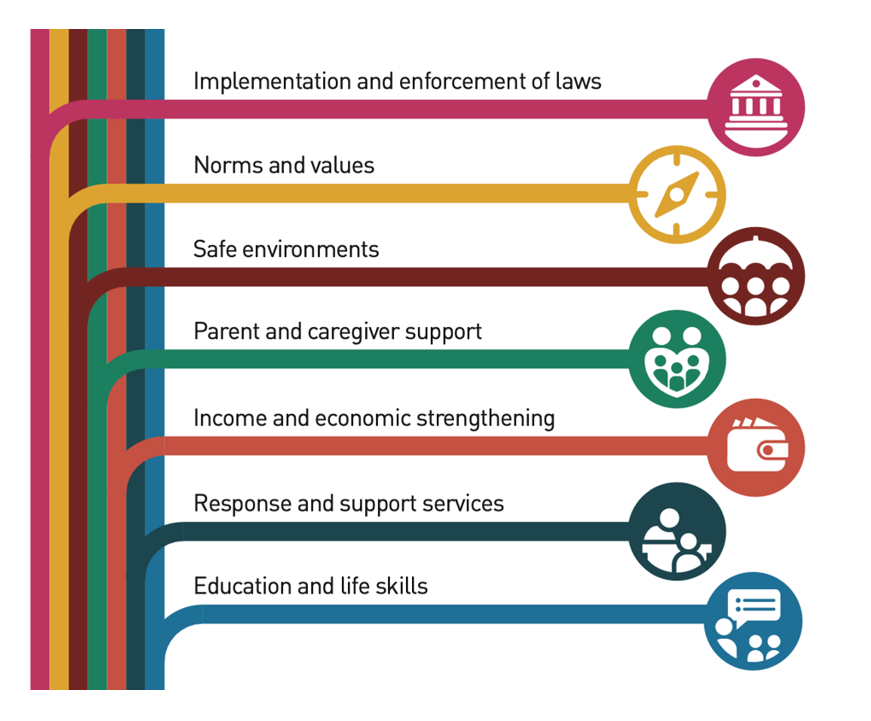
      The Seven Pillars of INSPIRE

      I

      Implementation and Enforcement of Laws

      INSPIRE encourages laws that ban violent punishment of children by parents, caregivers, teachers and other adults, along with laws criminalizing perpetrators of sexual abuse and exploitation of children. INSPIRE also found that laws preventing alcohol misuse and youth access to firearms (and other weapons) have been proven to decrease violence.

      N

      Norms and Values

      INSPIRE emphasizes the importance of changing harmful societal norms, which can target gender, ability level, age and other indicators. INSPIRE provides examples of effective community mobilization and bystander intervention programs.

      S

      Safe Environments

      INSPIRE has found a reduction in violence by addressing “hotspots.” Making environments safer with parks, public transportation, lighting after dark, or other strategies to reduce crime can halt the spread of violence throughout a community.

      P

      Parenting and Caregiver Support

      To truly stop violence against children, it is essential to engage parents and caregivers. INSPIRE provides ways of doing so, including home visits, group activities in community settings, and other evidence-based programs that target parents and caregivers.

      I

      Income & Economic Support

      Violence can often be prevented if a family’s financial status improves. INSPIRE outlines interventions that strengthen families’ economic standing, including cash transfers, group savings and loans programs combined with gender equity training, and microfinance initiatives combined with gender norm training.

      R

      Response & Support Services

      INSPIRE provides examples of effective counselling and therapeutic approaches, screening combined with interventions, and treatment programs for juvenile offenders in the criminal justice system. In addition, the package includes foster care interventions that involve existing social welfare services.

      E

      Education & Life Skills

      INSPIRE provides recommendations for increasing enrollment in preschools, primary schools and secondary schools, and relays the importance of safe, enabling school environments. By increasing children’s knowledge about violence and sexual exploitation, children are less likely to become victim to such abuses, making life skills and social training an essential part of the INSPIRE package.

      Collaborating Agencies

      The World Health Organization (WHO)

      INSPIRE was initially developed by the World Health Organization (WHO), UNICEF and the Centers for Disease Control and Prevention (CDC), in collaboration with the following organizations:

      United States Centers for Disease Control and Prevention (CDC)

      ISPCAN

      The Pan American Health Organization (PAHO)

      The President's Emergency Program for AIDS Relief (PEPFAR)

      Together for Girls

      The United Nations Children's Fund (UNICEF)

      The United Nations Office on Drugs and Crime (UNODC)

      The United States Agency for International Development (USAID)

      The World Bank

      CPC Learning Network at Columbia University

      Joining Forces

      The CSO Forum

      INSPIRE Evidence Lab at Georgia State University