Rise Up Policy Forum

An international community of practice for governments, policymakers, researchers, and practitioners: connecting the dots, learning together, and doing better.

rise-up-hero-dots
5 children die every day
because of child abuse
1 in 5 girls and 1 in 7 boys
is sexually abused
Over 1 billion children
are subjected to violence each year
Rise Up Policy Forum

An International Community of Learning

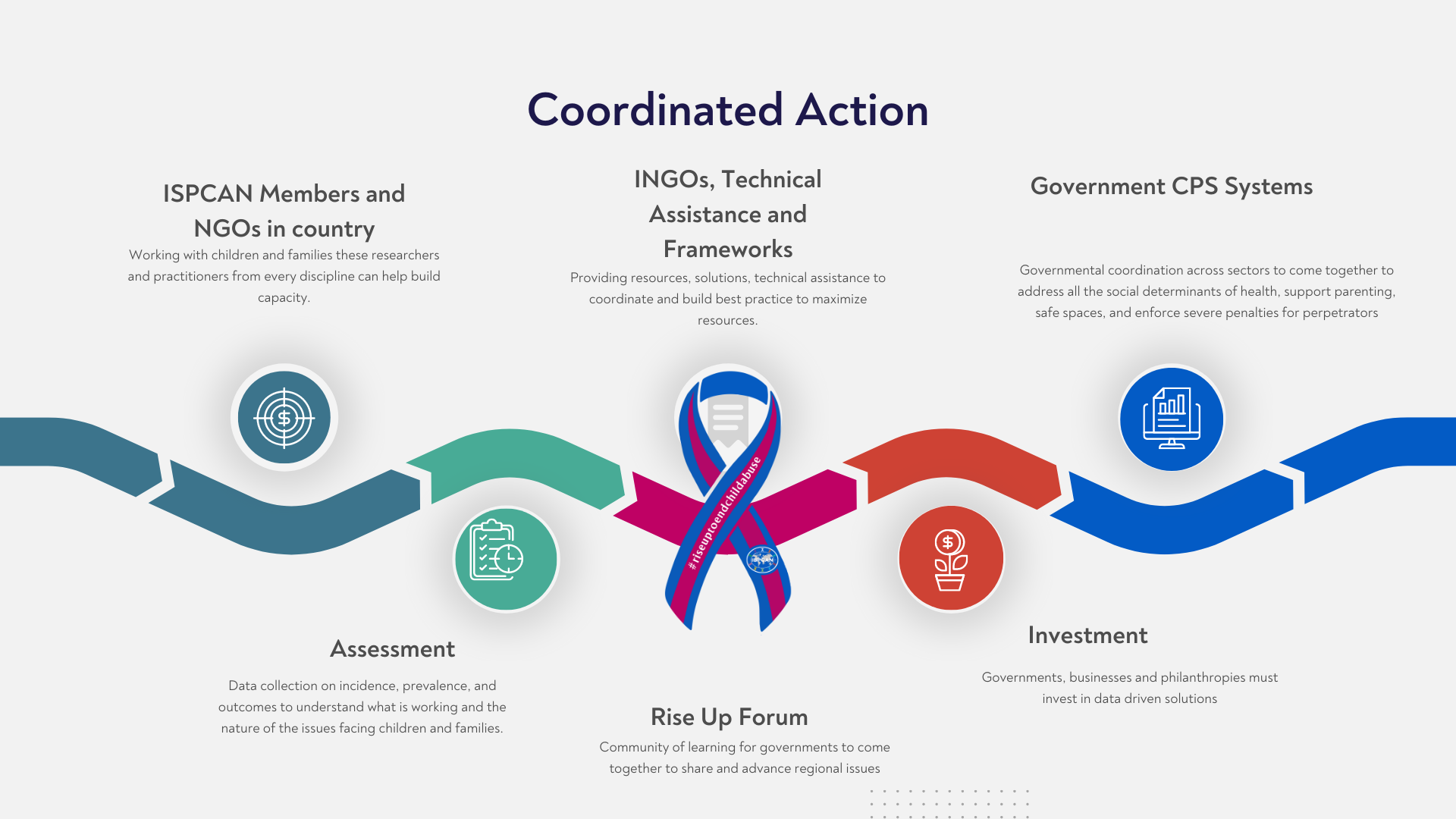
Governments working on policy changes can be part of an educational forum to learn from one another, connect to ideas, tools and resources across practice and data to transform child protection systems.

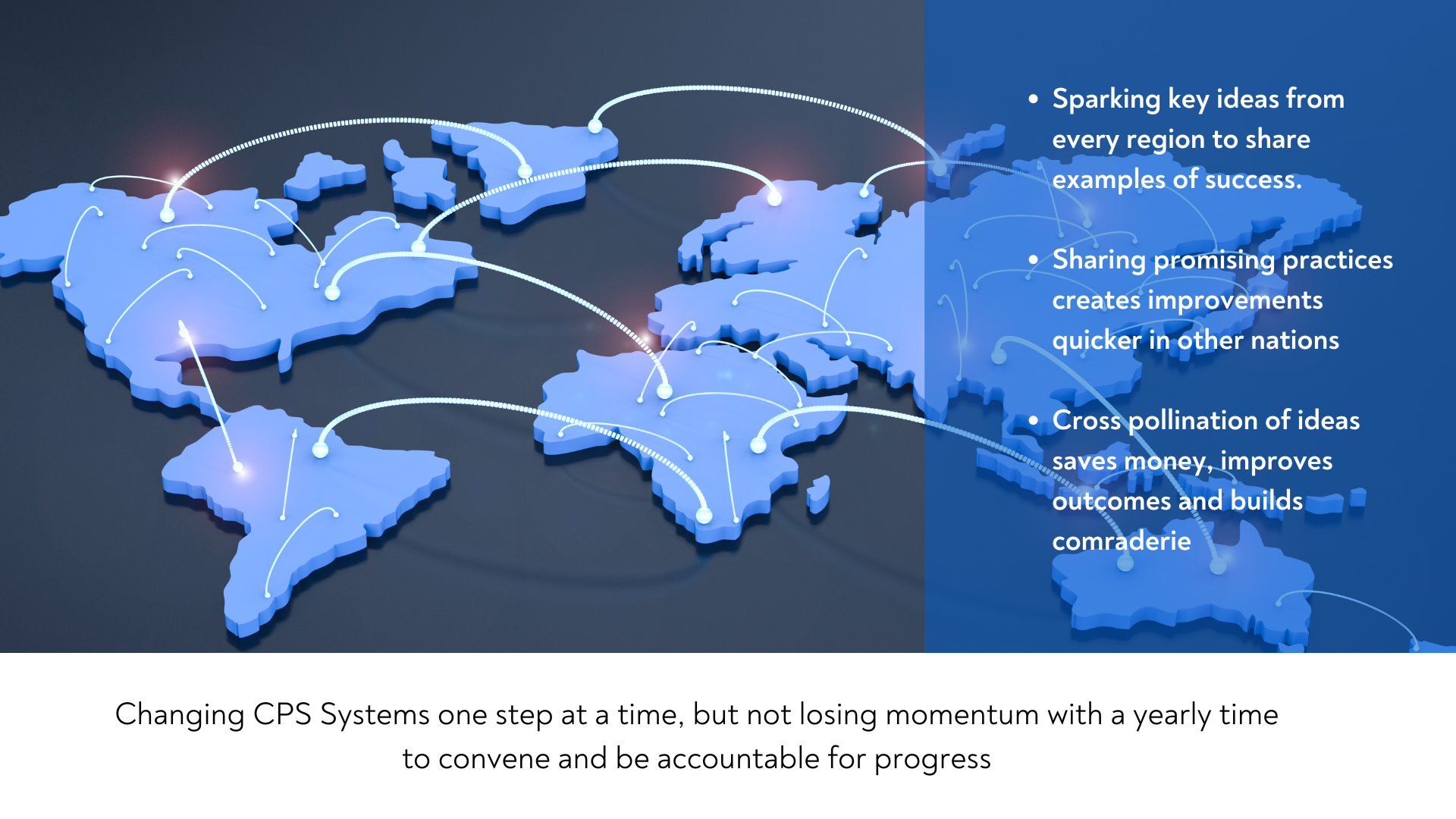
Foster a community of learning for countries and regions

Bring together policymakers, practitioners, researchers, survivors and youth leaders at the annual flagship ISPCAN International Congress to co-create solutions and exchange best practices.

Advance child protection policies

Promote the development and implementation of effective, evidence-based child protection policies grounded in public health principles at local, national, and global levels.

Integrate research and practice

Encourage alignment of data and research with practical applications to inform shareable data-driven solutions and enhance accountability.

Catalyze regional solutions

Develop context-specific, scalable strategies that address regional challenges and support sustainable, community-led change.

Resource maximization and sector collaboration

Optimize use of resources and cross-sector collaboration to assist governments in child protection prevention and response.

A public health approach

Promoting a public health approach to ending child abuse and neglect

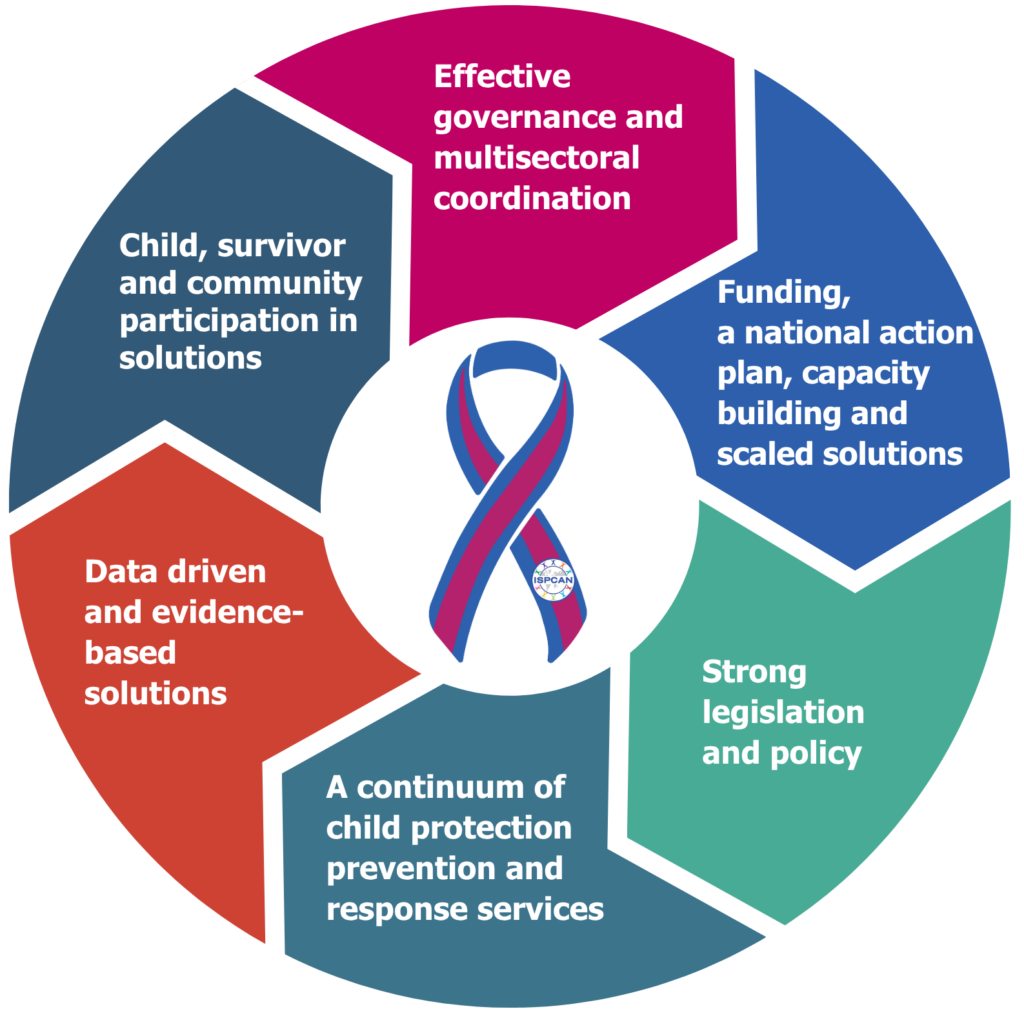
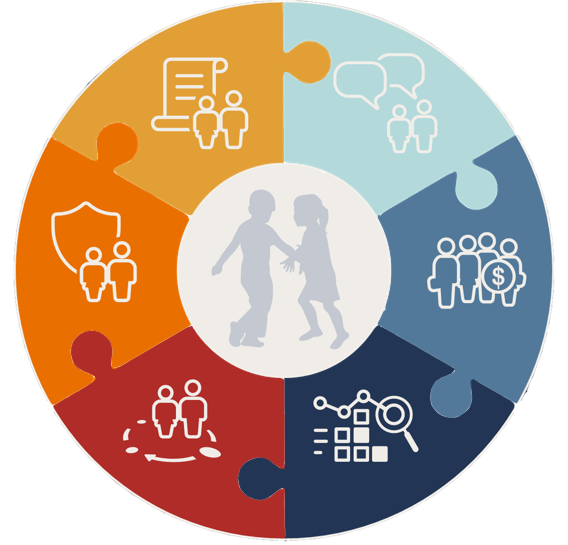
The ISPCAN Rise Up Policy Forum aims to help countries improve the foundations of child protection by advancing the six pillars of a public health and system-strengthening approach to preventing child abuse and neglect. Together these pillars form the basis of a strong child protection system.

Who is the Rise Up Policy Forum for?

Policy makers, researchers & practitioners from every sector

NGO's & partner organizations

Government agencies from county, state, and country level

How the Forum was developed

Rise Up Forum Development

Rise Up Policy Brief · 2026

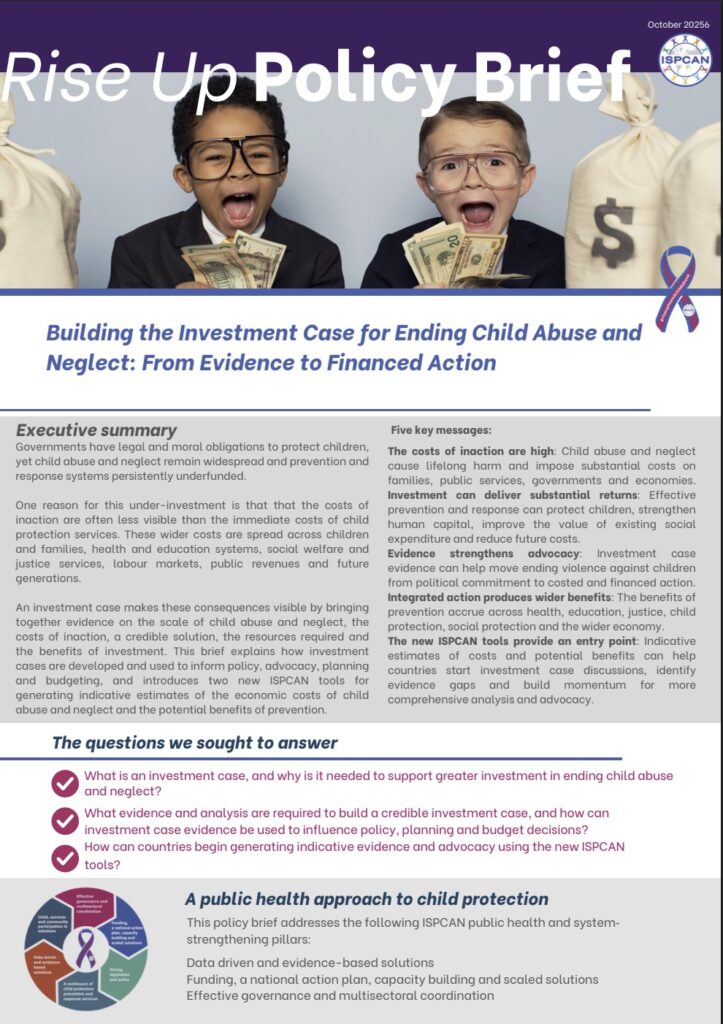
Building Political Will and the Finance Case

Governments have legal and moral obligations to protect children, yet child abuse and neglect remain widespread and prevention and response systems persistently underfunded.

One reason for this under-investment is that the costs of inaction are often less visible than the immediate costs of child protection services. Those wider costs are spread across children and families, health and education systems, social welfare and justice services, labour markets, public revenues and future generations.

An investment case makes these consequences visible by bringing together evidence on the scale of child abuse and neglect, the costs of inaction, a credible solution, the resources required and the benefits of investment. This brief explains how investment cases are developed and used to inform policy, advocacy, planning and budgeting, and introduces two new ISPCAN tools for generating indicative estimates of the economic costs of child abuse and neglect and the potential benefits of prevention.

$7 trillion

Global estimates place the economic cost of violence against children at more than $7 trillion — over 8% of global GDP.

Fewer than 1 in 4

Of 155 countries surveyed, 80% had a national action plan to prevent violence against children — but fewer than one in four had fully funded it.

Five questions a strong investment case answers

The value of an investment case lies in the coherence of the complete argument: the proposed solution must respond to the problem identified, its cost must reflect a realistic implementation plan, and estimates of impact must be grounded in credible evidence.

The problem

What forms of child abuse and neglect persist, who is most affected, and where are the principal service or system gaps?

The cost of inaction

What are the human, social, fiscal and economic consequences of failing to act?

The solution

What evidence-informed interventions, services and system reforms are required?

The implementation cost

What resources are required, over what period, and how affordable is the proposed investment?

The potential benefits

What harm could be prevented, what public costs avoided, and what gains in health, education, human capital and wellbeing achieved?

“For less than 1% of the total budget, government can address a problem that affects 4.1 million children and is costing Zambia 9.12% of GDP.”

The final advocacy message from the investment case for strengthening Zambia’s child protection social service workforce — one of the case studies in the brief.

Rise Up to end child abuse and neglect through ongoing learning, cross-sector collaboration, practical solutions and system strengthening

The Vision
A world free from child abuse and neglect
The Goal

Create a community of learning, sharing and networking

Our Hope

Make child protection a winnable battle for all governments

Melbourne 2026 · SECOND INTERNATIONAL RISE UP POLICY FORUM

Second International Rise Up Policy Forum, Melbourne Australia, 27 August 2026

ISPCAN’s second international Rise Up Policy Forum landed in Melbourne on 27 August 2026, a year on from its bold launch at the 2025 ISPCAN Congress in Vilnius, Lithuania. This time, 350 multisectoral experts — including 69 government delegates, alongside researchers, practitioners, survivors, youth and activists, funders, NGOs and faith leaders from 40 countries — came together for a single, intensive day of exchange.

In the opening plenary, ISPCAN CEO Pragathi Tummala argued that child protection is a “winnable battle” if it shifts from fragmented, reactive responses to a financed, coordinated, prevention-oriented public health system.

Sustainable funding was a priority theme, with four dedicated sessions and the launch of a policy brief, advocacy kit and two new ISPCAN ‘plug-and-play’ tools to help governments build the investment case for prevention.

Spotlight provocations from government, police, faith, funder and research perspectives — from Finland’s Marjo Malja questioning whether “we really want algorithms raising our children,” to INTERPOL’s Mark Beavan naming child protection’s “connection problem” over its knowledge problem, to World Vision’s call to work through faith networks rather than around them.

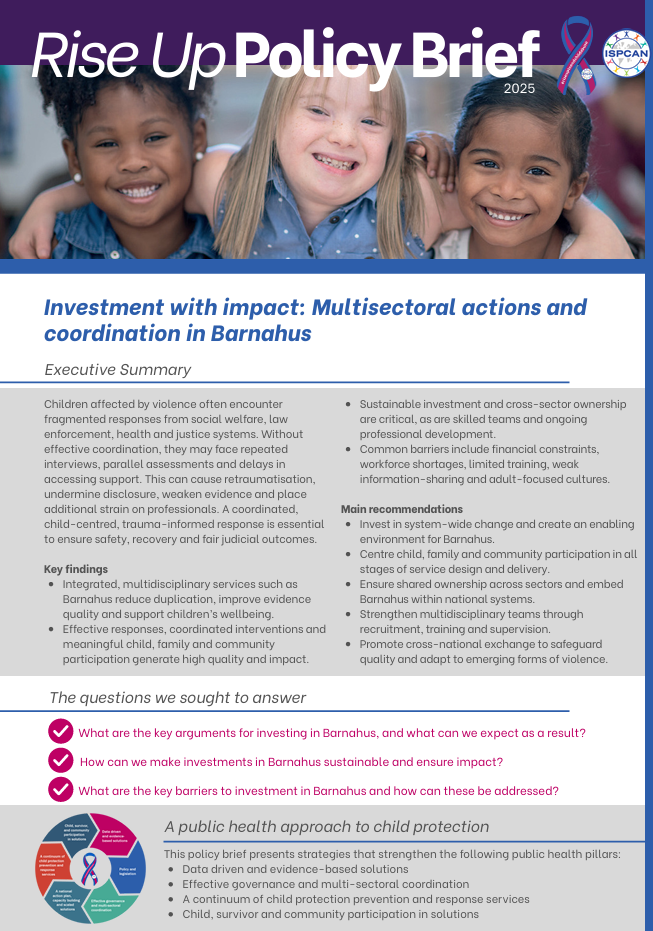
Across 25 Mastermind sessions built around six public health system-strengthening pillars, participants discussed country case studies, scaled upstream prevention, sustaining child protection during retrenchment, multisectoral coordination, care reform, scaling parenting interventions, the beliefs underpinning child protection systems and so much more. 

Participants valued the candid cross-jurisdiction discussion and the connections between government officials.

The first Melbourne policy brief is already available, and a special issue of Child Protection and Practice is coming.
ISPCAN Melbourne Congress Logo with dates of August 24-27, 2026
Knowledge Hub

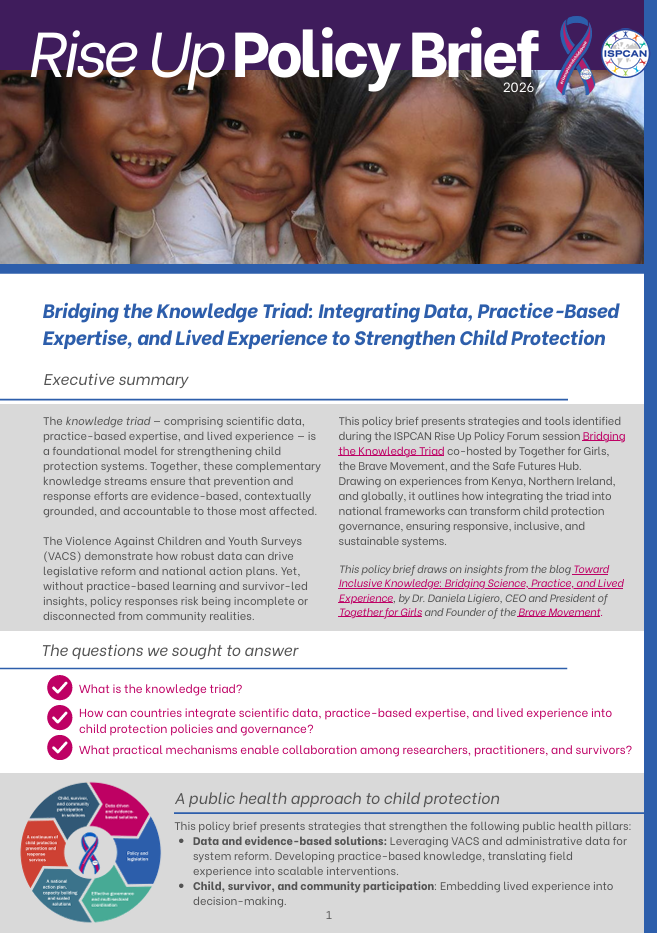
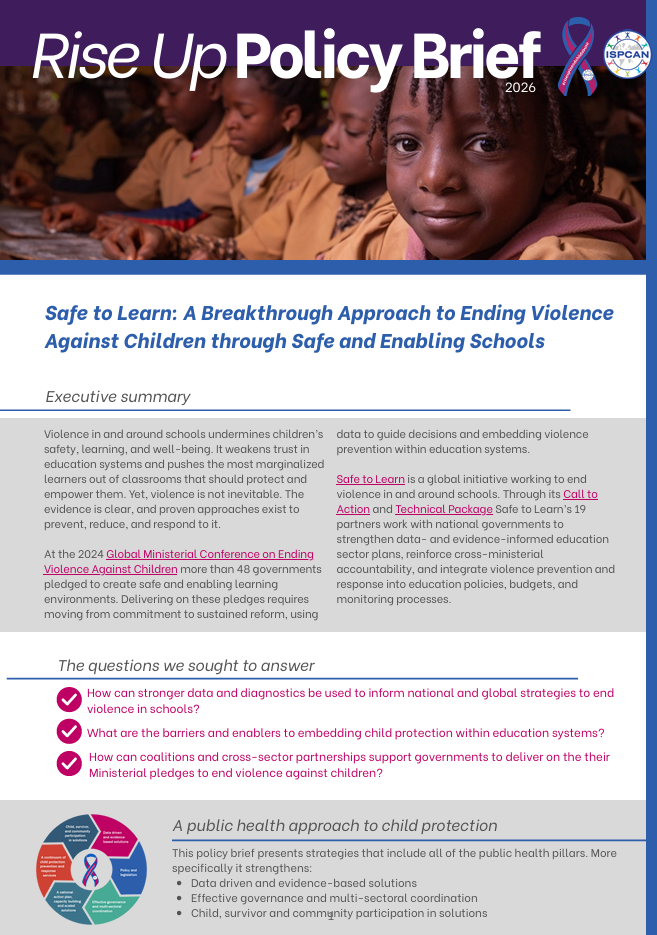
Rise Up Policy Forum Policy Briefs

Get involved in the Rise Up Policy Forum at our events

Attend a skill building workshop

Network with fellow policy makers

Share resources, data or best practice

Organize a breakthrough session

Learn about and address common challenges

Be part of problem-solving dialogue and co-creation

RISE UP WITH ISPCAN

  • Raise Awareness
  • Promote Education
  • Encourage Collective Action
  • Amplify Children’s Voices
  • Build Global Solidarity
A letter to funding partners

Funders Roundtable

We hope you will join us in shaping a more coordinated and sustainable future for child protection financing with honest dialogue. As child protection continues to evolve as a global priority, we recognize that sustainable progress depends not only on effective policies, research, and practice, but also on strategic, coordinated, and long-term investment.

During the early development of the Rise Up Policy Forum initiative, funders were identified as an essential pillar of the child protection ecosystem. As the initiative moves from concept to implementation and focuses increasingly on strengthening national child protection systems, there is a unique opportunity to bring together funding and development partners to discuss how investment strategies can better support long-term, sustainable change. Building resilient systems focused more on prevention is the goal.

This roundtable is intended to provide a trusted and informal space for open dialogue among funders. Our hope is that the discussion will explore broader questions around how funding can better support country-led child protection system strengthening to effectively enable sustainable impact. We invite you to share perspectives on emerging priorities, identify common challenges, and explore opportunities for greater coordination across the global child protection landscape.

Please use this online form: Registration of Interest to let us know if you want to be part of this brainstorming conversation. We invite you to also participate in the Rise Up Policy Forum and ISPCAN Congress to contribute to the solutions think tank we are building with research, practice and policy built around systems strengthening in real world scenarios. We plan to host a closed forum, by invitation only for Funders to share the challenges and opportunities that will convene in person at each ISPCAN Congress.
Sincerely,
Pragathi Tummala
CEO | ISPCAN
Luxolo Matomela-Kröger
Senior Technical Advisor | GIZ VPPIC

Rise Up Policy Forum Partners

Special Representative of the Secretary-General on Violence Against Children

UNICEF for every child

World Health Organization

HGFD

ECPAT International - End Child Exploitation

International Association of Family Support Networks

International Centre for Missing and Exploited Children (ICMEC)

Sexual Violence Research Initiative (SVRI)

SOS Children's Villages International

The Alliance for Child Protection in Humanitarian Action

To-Zero

Together for girls

World Vision

The INSPIRE Working Group

Save the Children

The Government of Lithuania

Parenting for Lifelong Health

ECDAN

National Commission for the Promotion of the Rights and the Protection of Children and Young People, Portugal

Kids First Australia

International Rescue Committee

Somali Federal Republic Ministry of Family and Human Rights Development

Centre for Excellence in Child and Family Welfare, Australia

National Council for Family Affairs, Jordan

Impact Initiative

Victoria State Government

Safe Futures Hub

Violence, Evidence, Guidance, Action (VEGA) Project, McMaster University

Ministry of Health, Namibia

Public Health Wales

National Council on the Administration of Justice, Republic of Kenya

Down to Zero

Australian Childhood Foundation

Department of Special Investigation, Thailand

Dubai Police

Ministry of Gender, Labour, and Social Development, Govt of Uganda

The Early Institute, Mexico

Safe to Learn

Centre for Global Development

Coalition for Good Schools

National Institute of Pediatrics, Mexico

Institute for Family Health, Jordan

Global Initiative to Support Parents

Anglicare Victoria

Terre des Hommes Netherlands

Social Economic Council, Netherlands

Barnahus Network

Barnahus Slovenia

Australian Centre for Child Protection

CAC Resources, LLC

Global Social Service Workforce Alliance

Family Resource Centre National Forum, Ireland

CPSS Framework for Action Task Team

Financial Intelligence Unit, Government of Peru

“Safety and security don’t just happen, they are the result of collective consensus and public investment. We owe our children, the most vulnerable citizens in our society, a life free of violence and fear.”

-Nelson Mandela, First Black South African President + Civil Rights Activist

Together with our members and partners we deliver:

Join ISPCAN today!