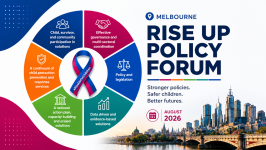
ISPCAN International Congress & Rise Up Policy Forum: Join 1,000+ child protection professionals in Melbourne, Australia August 24–27, 2026.

Pacific Regional Hub
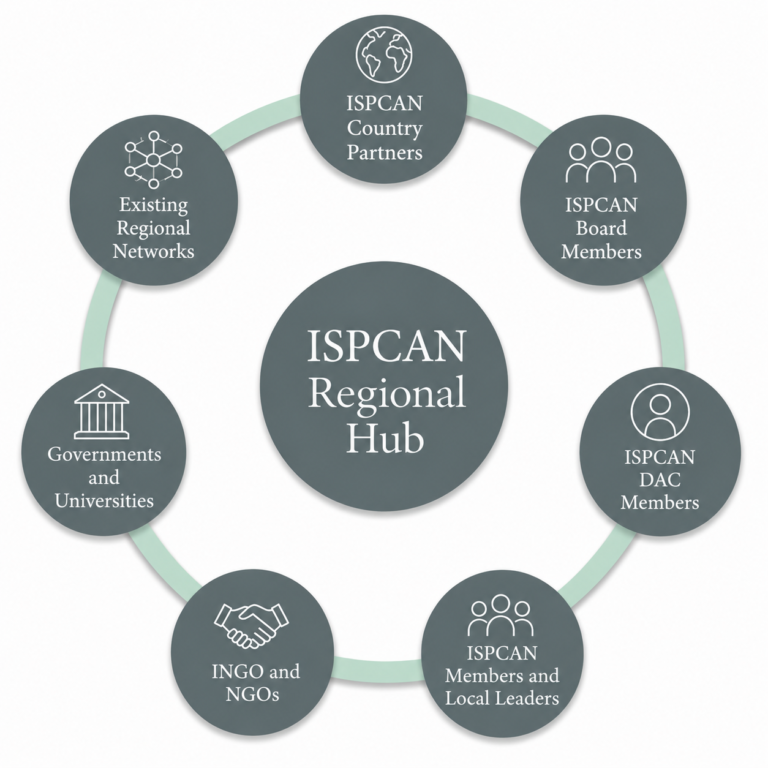
The Pacific Regional Network is a group of multidisciplinary professionals working in child abuse & neglect in the region connecting, learning, sharing ideas, research & knowledge.
ISPCAN-Hubs-Pacific

Pacific Regional Hub Partners

Australia
australian_childhood_foundation1-1536x643
Australian Childhood Foundation
Australia
ACULogo
ACU (Australian Catholic University) Institute of Child Protection Studies
Australia
Napcan Logo
National Association for Prevention of Child Abuse and Neglect (NAPCAN)

Pacific Regional Hub Resources

Do you...

Type of Resource
Resource Type
ISPCAN-resource
Rise Up Session
Making Child Death Review happen: solutions to the challenge of developing population-based child death review programmes
ISPCAN-resource
Rise Up Session
What Australia is learning about stronger online protections for children and young people: the evidence on social media age restrictions, privacy, digital duty of care and more
RUPF Melbourne
Rise Up Session
Redesigning Intervention Pathways for Infants and Young Parents at risk of child protection reports.
Moderator By:
Jennifer Weber

Contributing Partners:

Brave Foundation
Impact initiative
Victoria State Government, Australia
RUPF Melbourne
Rise Up Session
What Is the Child, in the Eyes of the System?
Presented By:
Dr Bengianni Halil-Pizzirani
Imogen Gerrarty
Deb Tsorbaris
Sue-Anne Hunter
Torres Strait

Contributing Partners:

Impact Initiative
Department of Social Services, Government of Australia
Australian Human Rights Commission
RUPF Melbourne
Rise Up Session
'Hubbing' Our Way Out of Crisis: Rethinking Child Protection Through Upstream Support
Presented By:
Prof Sharon Goldfeld
Dr Suzy Honisett
Deb Tsorbaris
Andrew Russo

Contributing Partners:

Murdoch Children's Research Institute
International Association of Family Support Network
Australian Human Rights Commission
National Child and Family Hubs Network 
RUPF Melbourne
Rise Up Session
Child Protection in a Borderless Digital World: Co-Designing Child-Centred Privacy Policy
Presented By:
Muhamad Nuzul
Rys Farthing

Contributing Partners:

ChildFund Australia
Reset.Tech
ASEAN Commission on the Promotion and Protection of the Rights of Women and Children
University of Canberra
RUPF Melbourne
Rise Up Session
Artificial intelligence in child and family services: measuring impact and strengthening early intervention systems
Presented By:
Dr Carmel Goulding
David Poynter
Mark Davis

Contributing Partners:

Centre for Excellence in Child and Family Welfare
Anglicare Victoria
Today
RUPF Melbourne
Rise Up Session
Making Practice Visible: How Aotearoa New Zealand Uses a National Practice Framework and Public-Facing Practice Centre to Build Trust and Strengthen Child Protection Systems
Presented By:
Jacqui Daniels
Kellie Blyth

Contributing Partners:

Oranga Tamariki – Ministry for Children, Government of Aotearoa New Zealand
RUPF Melbourne
Rise Up Session
From Fragmentation to Coherence: How Education-Centred Cross-Sector Practice Can Prevent Child Harm
Presented By:
Janette Searle
Scott Samson
Te Rau Allen

Contributing Partners:

NorthAble Matapuna Hauora
Ministry of Education, Government of Aotearoa New Zealand
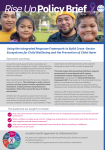
Integrated Response Framework
Childlight horizontal
Global Report
INTO THE LIGHT Index on Global Technology-Facilitated Child Sexual Exploitation and Abuse 2026
Childlight’s Into the Light Index on Global Technology-Facilitated Child Sexual Exploitation and Abuse 2026 Data Update

Contributing Partners:

CHILDLIGHT Global Child Safety Institute
Human Dignity Foundation
The University of Edinburgh
Image To Zero - Fundraising Guide for Child Sexual Abuse Prevention
Global Report
To Zero - Fundraising Guide for Child Sexual Abuse Prevention
First published in 2024 and updated in 2025, the guide has since become a practical, widely referenced resource for organizations working to prevent child sexual abuse

Contributing Partners:

To Zero
Panorama Strategy
Growing up safe image
Global Report
To Zero - Growing Up Safe - A narrative & messaging guide
To Zero has launched Growing Up Safe, a messaging guide that supports advocates and practitioners in advancing a new narrative about childhood sexual violence — one that focuses on prevention.

Contributing Partners:

ToZero
Spitfire
Out of the Shadows Index
Global Report
2026 Out of the Shadows Index
The Out of the Shadows Index measures global and country-level efforts to address sexual violence against children and adolescents.

Contributing Partners:

Together for Girls
Ecinomist Impact
UN Convention Rights
Downloadable Resource
UN Convention on the Rights of the Child
1.The Convention on the Rights of the Child defines a child as every human being below the age of 18 years unless under the law applicable to the child majority is attained earlier, and emphasizes that States should respect and ensure the rights embodied in the Convention to each child within their jurisdiction without discrimination of any kind. While the Convention recognizes the rights of all persons under 18 years, the implementation of rights should take account of children’s development and their evolving capacities. Approaches adopted to ensure the realization of the rights of adolescents differ significantly from those adopted for younger children.
2.Adolescence is a life stage characterized by growing opportunities, capacities, aspirations, energy and creativity, but also significant vulnerability. Adolescents are agents of change and a key asset and resource with the potential to contribute positively to their families, communities and countries. Globally, adolescents engage positively in many spheres, including health and education campaigns, family support, peer education, community development initiatives, participatory budgeting and creative arts, and make contributions towards peace, human rights, environmental sustainability and climate justice. Many adolescents are at the cutting edge of the digital and social media environments, which form an increasingly central role in their education, culture and social networks, and hold potential in terms of political engagement and monitoring accountability.
3.The Committee observes that the potential of adolescents is widely compromised because States parties do not recognize or invest in the measures needed for them to enjoy their rights. Data disaggregated by age, sex and disability are not available in most countries to inform policy, identify gaps and support the allocation of appropriate resources for adolescents. Generic policies designed for children or young people often fail to address adolescents in all their diversity and are inadequate to guarantee the realization of their rights. The costs of inaction and failure are high: the foundations laid down during adolescence in terms of emotional security, health, sexuality, education, skills, resilience and understanding of rights will have profound implications, not only for their individual optimum development, but also for present and future social and economic development.
4.In the present general comment, the Committee provides guidance to States on the measures necessary to ensure the realization of the rights of children during adolescence, cognizant also of the 2030 Agenda for Sustainable Development. It highlights the importance of a human rights-based approach that includes recognition and respect for the dignity and agency of adolescents; their empowerment, citizenship and active participation in their own lives; the promotion of optimum health, well-being and development; and a commitment to the promotion, protection and fulfilment of their human rights, without discrimination.
5.The Committee recognizes that adolescence is not easily defined, and that individual children reach maturity at different ages. Puberty occurs at different ages for boys and girls, and different brain functions mature at different times. The process of transitioning from childhood to adulthood is influenced by context and environment, as reflected in the wide variation in cultural expectations of adolescents in national legislations, which afford different thresholds for entry into adult activities, and across international bodies, which employ a variety of age ranges to define adolescence. The present general comment does not seek, therefore, to define adolescence, but instead focuses on the period of childhood from 10 years until the 18th birthday to facilitate consistency in data collection.
6.The Committee notes that several of its general comments have a particular resonance for adolescents, notably those relating to adolescent health and development, HIV/AIDS, eradicating practices that are harmful to women and children, unaccompanied and separated children and juvenile justice. The Committee emphasizes the particular significance for adolescents of the recommendations arising from the day of general discussion on digital media and children’s rights. The present general comment has been developed to provide an overview on how the Convention in its entirety needs to be understood and implemented in respect of all adolescents and should be read together with other general comments and with documents arising from the day of general discussion.
IMAGE-~1
Inspire
Ending Corporal Punishment of Children: A short Guide to Effective Law Reform

Contributing Partners:

Global Initiative to End all Corporal Punishment of Children
IMAGE-~1
Inspire
Ending Corporal Punishment in Schools to Transform Education for All Children

Contributing Partners:

End Corporal Punishment
Safe to Learn
Collation for Good Schools
End Violence Against Children
RESOUR~1
Inspire
The Positive Impact of Prohibition of Corporal Punishment on Children's Lives - Messages from Research

Contributing Partners:

End Corporal Punishment
End Violence Against Children
RUPF Vilnius
Rise Up Session
Sector Strategies to Align Evidence, Technology, and Policy

Contributing Partners:

Centre for Excellence in Child and Family Welfare, Australia
Australian Childhood Foundation
Kids First Australia
Anglicare Victoria
Impact Initiative
Victoria State Government
ISPCAN-resource
Downloadable Resource
LINKS - An Innovative Model for the Comprehensive Assessment of Children referred after Child Protection Involvement
1. To provide a multidisciplinary trauma-informed outpatient health and developmental assessment for at risk children and their siblings (0-5 years old) referred to CPU. 2. To identify developmental and medical needs and link with community-based early intervention services
Country Profiles
Downloadable Resource
New Zealand - Child Protection Country Profile
This Country Data Profile is based on information provided by knowledgeable professionals in the country. It is often difficult to capture the varying circumstances and ISPCAN was unable to verify the accuracy of the information. It is our hope that each profile offers a useful snapshot of issues related to child protection in each country. The 2020 World Perspectives survey was modified for this most recent data collection, mostly to help clarify the meaning of some questions and provide more guidance to respondents. Respondents were given a link to complete the survey online. The development of the survey was guided by input from an international advisory committee convened for the purposes of collecting country level data and who are acknowledged for their invaluable contributions. The content covered consideration of what circumstances were CM in the country; specific policies regarding CM; legal responses to child sexual exploitation (CSE); services used to address CM; prevention strategies; and barriers to prevention. Data was gathered between December 2019 and February 2020. It is important to note that data on many of the issues may not have been available, requiring respondents to provide educated estimates.
Country Profiles
Downloadable Resource
Australia - Child Protection Country Profile
This Country Data Profile is based on information provided by knowledgeable professionals in the country. It is often difficult to capture the varying circumstances and ISPCAN was unable to verify the accuracy of the information. It is our hope that each profile offers a useful snapshot of issues related to child protection in each country. The 2020 World Perspectives survey was modified for this most recent data collection, mostly to help clarify the meaning of some questions and provide more guidance to respondents. Respondents were given a link to complete the survey online. The development of the survey was guided by input from an international advisory committee convened for the purposes of collecting country level data and who are acknowledged for their invaluable contributions. The content covered consideration of what circumstances were CM in the country; specific policies regarding CM; legal responses to child sexual exploitation (CSE); services used to address CM; prevention strategies; and barriers to prevention. Data was gathered between December 2019 and February 2020. It is important to note that data on many of the issues may not have been available, requiring respondents to provide educated estimates.
Country Profiles
Downloadable Resource
Oceania - Child Protection Region Profile
The following Regional Data Profile is based on information provided by knowledgeable professionals in the country. It is often difficult to capture the varying circumstances and ISPCAN was unable to verify the accuracy of the information. It is our hope that each profile offers a useful snapshot of issues related to child protection in each country. The 2020 World Perspectives survey was modified for this most recent data collection, mostly to help clarify the meaning of some questions and provide more guidance to respondents. Respondents were given a link to complete the survey online. The development of the survey was guided by input from an international advisory committee convened for the purposes of collecting country level data and who are acknowledged for their invaluable contributions. The content covered consideration of what circumstances were CM in the country; specific policies regarding CM; legal responses to child sexual exploitation (CSE); services used to address CM; prevention strategies; and barriers to prevention. Data was gathered between December 2019 and February 2020. It is important to note that data on many of the issues may not have been available, requiring respondents to provide educated estimates. We obtained information from 62 countries including 10 countries in Africa, 9 in the Americas, 19 in Asia, 22 in Europe, and Australia and New Zealand in Oceania. Countries were also categorized by income level using designations by the World Bank; 27 countries had high income, 20 upper-middle income and 15 were low income. Those who responded are considered experts in their countries in different disciplines with knowledge of country-level data, and they were encouraged to consult with colleagues when uncertain of an answer. That said, ISPCAN was unable to verify the accuracy of responses. In conclusion, this report offers a snapshot of the state of CM and child protection across many countries across the globe. Taken together over the history of publication, much has been accomplished—especially in terms of awareness of the child maltreatment problem and the development of systems to address it. That said, concerns from infrastructure to expertise, to leveraging the lived experience of communities, remains a challenge made even more.