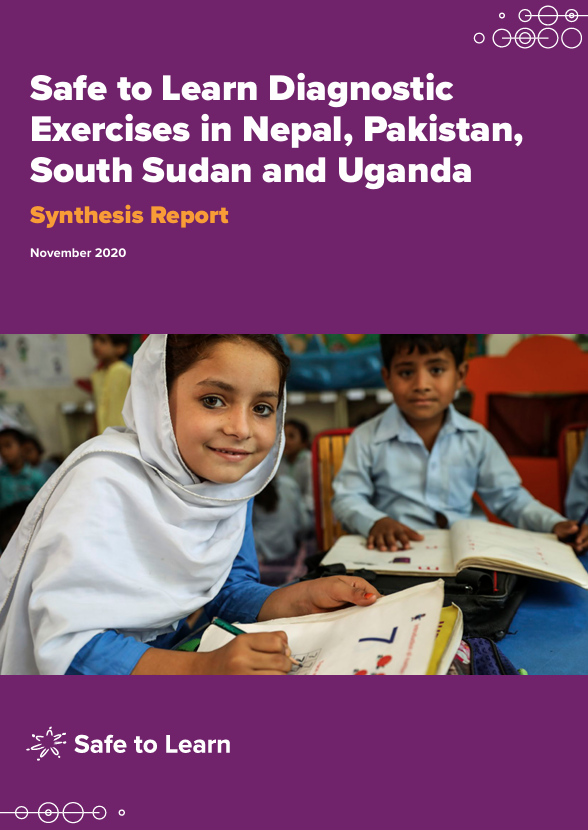
Violence in and around schools affects millions of children all over the world. Around 150 million students aged 13–15 – about half of all students aged 13–15 worldwide – face peer-to-peer violence in and around schools; approximately one in three students in the same age group experience bullying, and about the same proportion is involved in physical fights. About 720 million children of school-age live in countries where laws do not fully protect them from corporal punishment at school. “Safe to Learn” is a global initiative dedicated to ending violence against children in and through schools. It was launched in 2019 by a core group of members of the Global Partnership to End Violence against Children: United Nations Educational, Scientific and Cultural Organization (UNESCO), United Nations Girls’ Education Initiative (UNGEI), United Nations Children’s Fund (UNICEF) and the Department for International Development (DFID) of the United Kingdom (UK)
The Safe to Learn initiative addresses diverse forms of violence including:
• Violence perpetrated by teachers and other school staff - including corporal punishment, cruel and humiliating forms of psychological punishment, sexual exploitation and abuse and bullying Strategies to prevent violence in and around school need to be written explicitly in the education sector plan and accompanied with key indicators, action plans and budgets.
• Violence that takes place between peers in and around schools - such as bullying, sexual and gender based violence and physical and psychological violence; including online violence • Violence in the home and violence in the community that has an impact on schools
• Attacks on schools, understood as any intentional threat or use of force ― carried out for political, military, ideological, sectarian, ethnic, religious or criminal reasons ― against students, educators, and education institutions
The objectives of Safe to Learn are set out in a five-point Call to Action:
(1) implement policy and legislation
(2) strengthen prevention and response at the school level
(3) shift social norms and behaviour change
(4) invest resources effectively
(5) generate and use evidence.