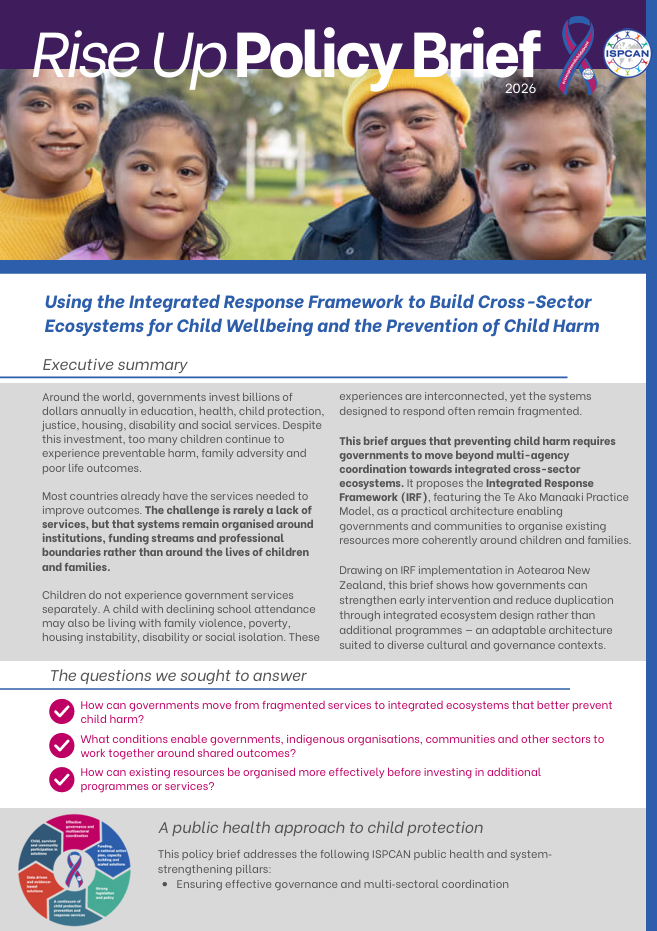
Around the world, governments invest billions of dollars annually in education, health, child protection, justice, housing, disability and social services. Despite this investment, too many children continue to experience preventable harm, family adversity and poor life outcomes.
Most countries already have the services needed to improve outcomes. The challenge is rarely a lack of services, but that systems remain organised around institutions, funding streams and professional boundaries rather than around the lives of children and families.
Children do not experience government services separately. A child with declining school attendance may also be living with family violence, poverty, housing instability, disability or social isolation. These experiences are interconnected, yet the systems designed to respond often remain fragmented.
This brief argues that preventing child harm requires governments to move beyond multi-agency coordination towards integrated cross-sector ecosystems. It proposes the Integrated Response Framework (IRF), featuring the Te Ako Manaaki Practice Model, as a practical architecture enabling governments and communities to organise existing resources more coherently around children and families.
Drawing on IRF implementation in Aotearoa New Zealand, this brief shows how governments can strengthen early intervention and reduce duplication through integrated ecosystem design rather than additional programmes — an adaptable architecture suited to diverse cultural and governance contexts.