By: Pragathi Tummala
Chief Executive Officer, International Society for the Prevention of Child Abuse and Neglect (ISPCAN)
In August, more than 350 experts across 40 countries gathered in Melbourne for ISPCAN’s second Rise Up Policy Forum. In my opening remarks, I asked a question I believe our whole field now has to answer: what does it take to turn what we know into what governments actually do?
We have spent decades improving our ability to recognize abuse and neglect, investigate it, and respond. That work remains essential. But response alone cannot reduce violence at population level. We know many of the risk factors. We know many interventions that work. Yet prevention remains underfunded, fragmented, and too often confined to pilots.
The implementation gap is now one of our greatest challenges. Rise Up exists to close it, and to make child protection a winnable battle: systems that prevent harm, support families earlier, and provide excellent response and healing when children need it.
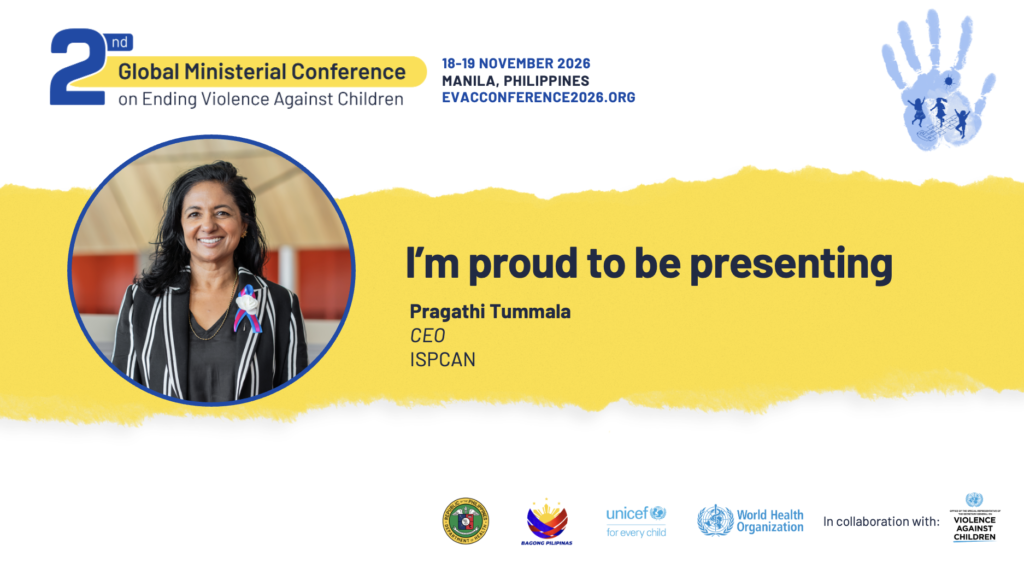
That question becomes urgent this week. On November 18-19, governments will meet in Manila for the Second Global Ministerial Conference on Ending Violence Against Children, hosted by the Government of the Philippines alongside WHO and UNICEF. At the first conference in Bogotá in 2024, more than 100 governments pledged concrete action. Manila is where countries review that progress and make new, stronger pledges. The test of those pledges will be implementation.
I’ll be in Manila to make that case, participating in three sessions:
We Are Already Paying for Violence — Just Too Late
Violence against children is not a niche social-service issue.
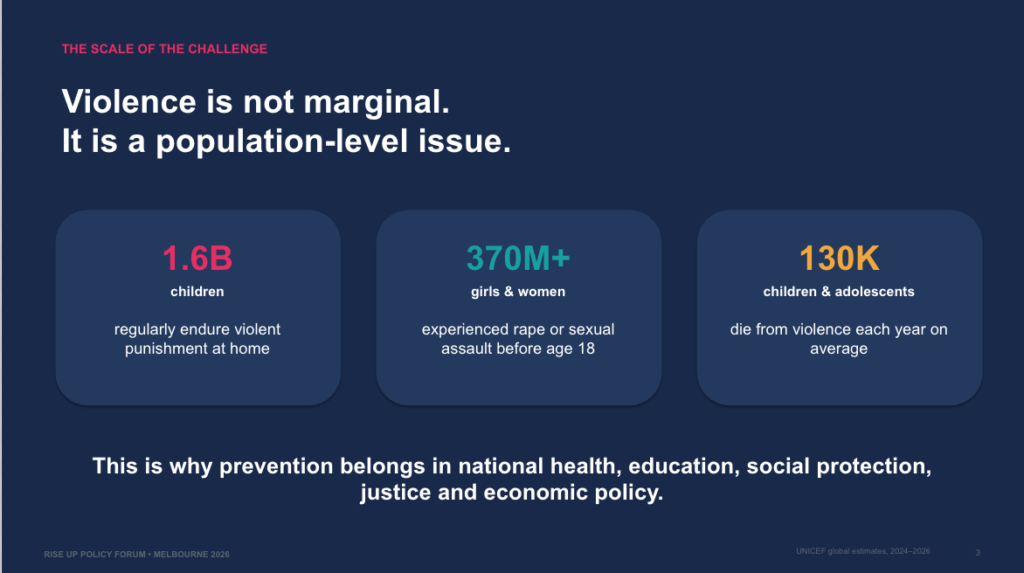
When violence affects children at this scale, every ministry is already paying for it — through health, education, justice, social welfare, and lost human potential. The economic cost of violence against children has been estimated at up to 8% of global GDP. In the Solomon Islands, it was estimated at 9.13% of GDP in 2021.
So our focus has to change. We are not asking governments to add one more child-protection program. We are asking them to recognize prevention as part of the basic infrastructure required for healthy populations and sustainable development.
The good news is that violence is preventable. The challenge has shifted: from proving prevention can work to financing, adapting, and scaling what works.
Beyond Survival: Why Health Can Lead
Since 2000, the global under-five mortality rate has fallen by roughly half. That is a historic achievement. But success creates a new responsibility. When more children survive, the question cannot stop at whether they are alive. We have to ask whether they can thrive.
Mortality tells us who we lost. Morbidity tells us what children are living with — and what prevention can change. WHO links child maltreatment to post-traumatic stress, anxiety and depression, injury and disability, poorer educational outcomes, and behaviours such as smoking, obesity, and substance misuse that feed later noncommunicable disease. Maltreatment can have life-long consequences, changing a child’s health trajectory across decades.
That is why Health ministers have a unique opportunity to lead. If a minister is responsible for mental health, non-communicable disease prevention, healthy development, and health equity, then preventing childhood violence is an upstream health policy.
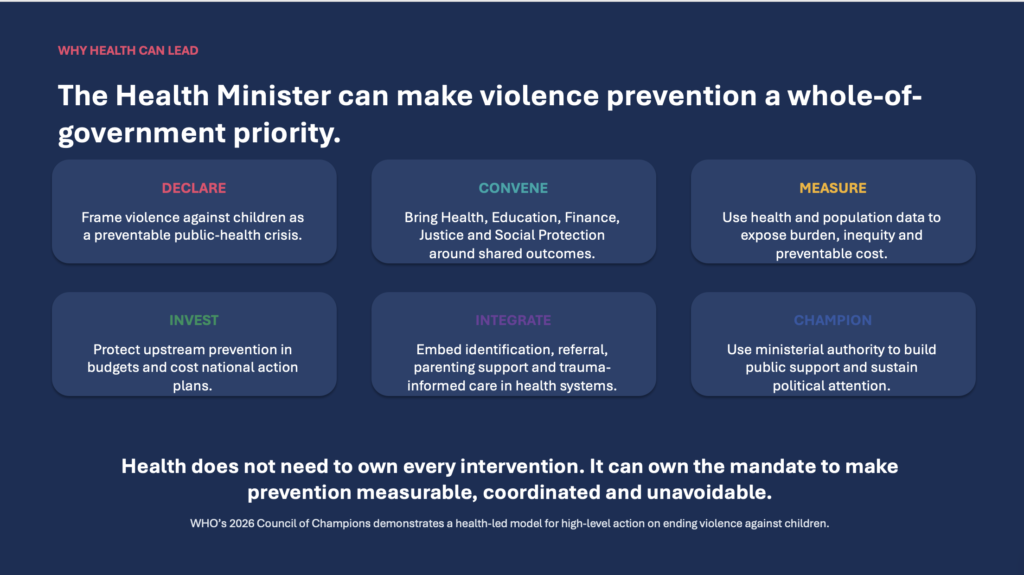
Health can declare violence against children a preventable public-health crisis. It can convene Education, Finance, Justice, and Social Protection around shared outcomes. Its data can make invisible consequences visible. And health systems can champion integration of early identification, referral, parenting support, and trauma-informed care. WHO’s Council of Champions is an important signal: health-led political leadership on ending violence against children is becoming a global model.
Same Child. Same Evidence. Different Entry Point.
Children do not experience five ministries. They experience one life. Yet too often we focus calls for change on one Ministry, with one message, instead of across Government. ISPCAN’s new Advocacy Toolkit gives leaders suggested messages, data, and template briefings for each ministry, built to move a decision: a budget line, a national plan, a law, or a commitment to scale.
Funding is where political commitment becomes visible. Prevention cannot scale through short grants and isolated pilots. It has to become infrastructure: costed national plans, core services, trained workforces, and sustainable budgets.
Questions to Consider
As governments prepare their pledges, I offer five questions as an implementation test for every national child-protection strategy:
In Melbourne, I asked every delegation to leave with something operational. I make the same ask of every government in Manila.
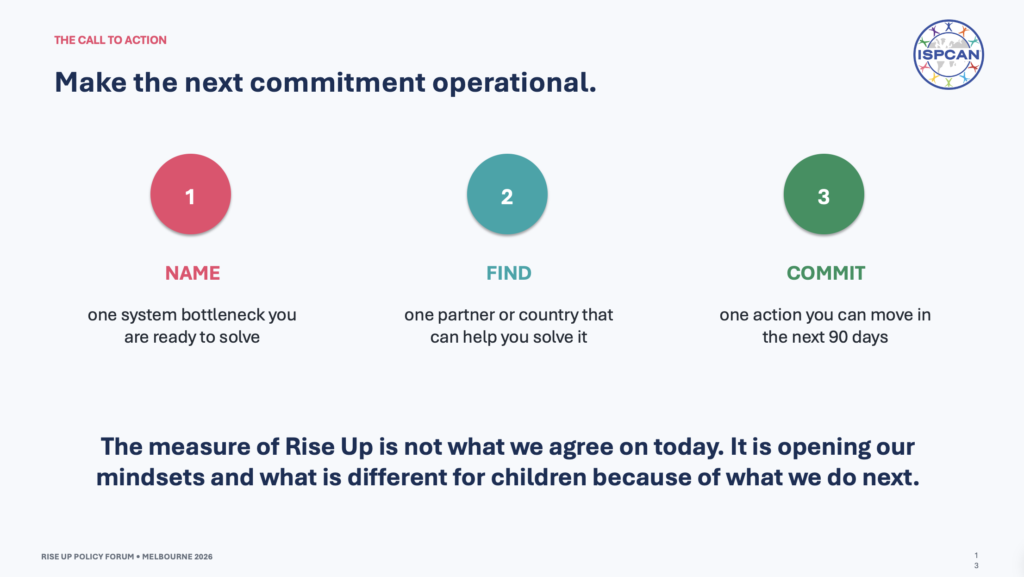
Political change can feel enormous. But systems change is built through sequences of concrete decisions. The measure of a pledge is not the words we agree on. It is different for children because of what we do next.
Child protection becomes a winnable battle when prevention stops being an optional program and becomes how the system works.
Preparing a call to action, a budget request, or briefing for a minister? Request access to ISPCAN’s Advocacy Toolkit for ministry-specific messages, data, and template briefings. You can also download our Investment Case Tools to estimate the cost of inaction and the return on prevention.
Learn more about the Rise Up Policy Forum.
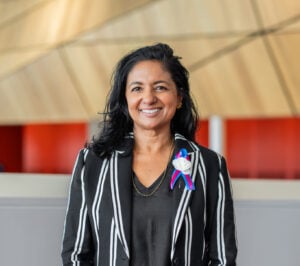 Pragathi Tummala is CEO of ISPCAN, the only multidisciplinary global network of child protection professionals, connecting more than 15,000 experts across 100+ countries to share insights, build capacity, and drive collaborative solutions that prevent child abuse and strengthen systems of care. A connector and convener working at the intersection of child protection policy and practice, she believes real breakthroughs happen when people come together across sectors, cultures, and silos. She has led ISPCAN through transformational change — expanding its global reach, launching new academic journals and campaigns, modernizing member engagement, and coordinating with 50+ country partners and 18 global agencies. In 2025, she launched the Rise Up Policy Forum to create space for honest dialogue and practical action between governments, policymakers, and the frontline professionals who make child protection possible.