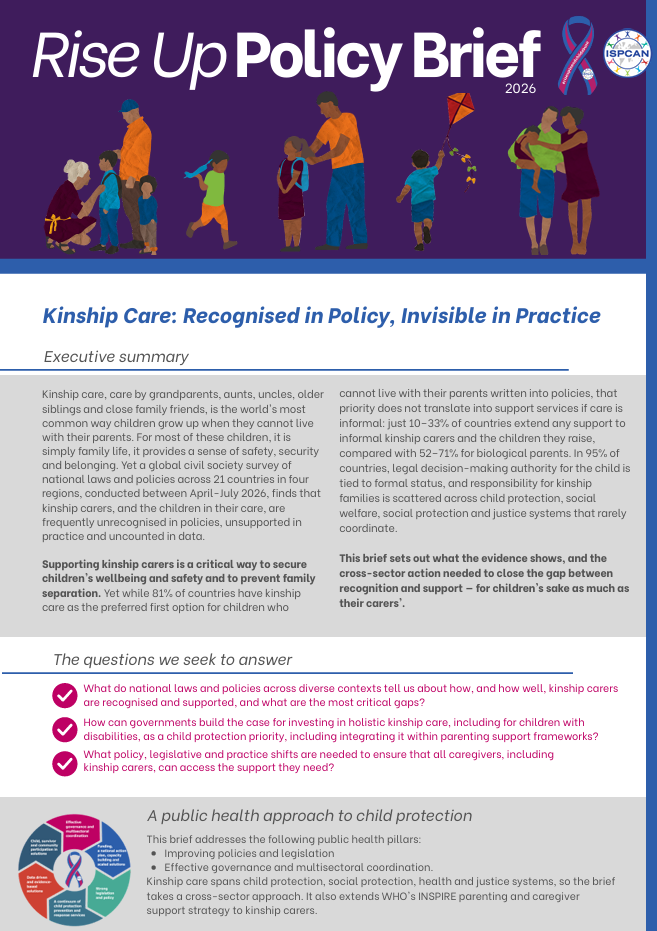
Kinship care, care by grandparents, aunts, uncles, older siblings and close family friends, is the world's most common way children grow up when they cannot live with their parents. For most of these children, it is simply family life, it provides a sense of safety, security and belonging. Yet a global civil society survey of national laws and policies across 21 countries in four regions, conducted between April-July 2026, finds that kinship carers, and the children in their care, are frequently unrecognised in policies, unsupported in practice and uncounted in data.
Supporting kinship carers is a critical way to secure children's wellbeing and safety and to prevent family separation. Yet while 81% of countries have kinship care as the preferred first option for children who cannot live with their parents written into policies, that priority does not translate into support services if care is informal: just 10–33% of countries extend any support to informal kinship carers and the children they raise, compared with 52–71% for biological parents. In 95% of countries, legal decision-making authority for the child is tied to formal status, and responsibility for kinship families is scattered across child protection, social welfare, social protection and justice systems that rarely coordinate.
This brief sets out what the evidence shows, and the cross-sector action needed to close the gap between recognition and support — for children's sake as much as their carers'