ISPCAN International Congress · Melbourne 2026

Celebrating the Melbourne Congress

In Melbourne we brought together the brightest minds in child protection from every sector to innovate and share best practices. This impactful congress pushed the boundaries of research and practice to ensure that all children have the chance to thrive no matter what their experience.

Join us for our next congress in Lugano Switzerland November 7-11, 2027

A letter from the congress chairs

Transforming approaches to safety and healing

As we close the ISPCAN 2026 Congress in Melbourne, we leave with more than new knowledge. We leave with renewed connection, shared purpose, and a deeper understanding of what becomes possible when we come together across professions, sectors, countries, cultures and lived experiences.

Melbourne became a truly global meeting place for child protection. Researchers learned alongside practitioners. Health professionals exchanged perspectives with colleagues from social services, education, justice, law enforcement and mental health. Policymakers heard from those working directly with children and families. People with lived experience and young people reminded us why this work matters and why our systems must continue to evolve. Special tracks led by First Nations people and young people were so inspiring.

The challenges facing children rarely fit neatly within the boundaries of one system. Trauma does not stop at the door of a hospital, school, courtroom or child protection agency. Neither should our response. But with scarce resources no single profession, agency or sector can protect children alone. The Rise Up Policy Forum brought together governments, researcher and practitioners helping to face real challenges with real world solutions. Solutions that require building the political will and investment to support coordinated action across sectors.

Building these stronger bridges between sectors allows us to see more of the whole child, the whole family and the circumstances surrounding them. It helps us recognize risks earlier, share knowledge more effectively, coordinate support and move further upstream toward prevention. Importantly, these bridges also support the people doing this extraordinarily demanding work to prevent secondary trauma. When systems are fragmented, children are more at risk and when they are harmed, the response also has gaps that cause further harm. Teachers, social workers, clinicians, researchers, police, lawyers, advocates and many others are too often asked to solve complex problems without the information, resources or partnerships they need. Multisectoral collaboration is therefore not only about improving outcomes for children—it is about creating stronger networks of support around every profession entrusted with their wellbeing to prevent harm before it even happens. Our working groups each took a thematic topic and went deeper into looking at gaps and opportunities for global solutions.
Our shared aspiration is ultimately simple: less trauma for children and families by design. Fewer children reaching crisis before receiving help. Fewer families navigating disconnected systems. Earlier opportunities to prevent harm. Better support when harm occurs. And stronger communities and systems that allow children not simply to survive adversity, but to thrive. The conversations in Melbourne demonstrated the extraordinary knowledge that already exists across our global community. Our challenge now is to connect it. So as you return to your countries and communities, we encourage you to reach beyond your discipline to build new partnerships. Bring research closer to practice and practice closer to policy so we change systems. Include children, families and lived experience in shaping solutions and continue building the relationships that make coordinated action possible.

Thank you to every delegate, speaker, partner, volunteer, practitioner, researcher, policymaker, sponsor, exhibitor and person with lived experience who contributed their knowledge and energy to Melbourne 2026. The generosity with which you shared ideas, challenges and solutions is what makes the ISPCAN community so powerful. We sincerely thank the partners who arranged site tours and opportunities to see local and regional child protection programs and centers of excellence, inspiring international colleagues.

We leave Melbourne connected across more than geography. We leave connected by a shared belief that child abuse and neglect are preventable—and that by learning from one another, supporting one another and working across traditional boundaries, we can build systems that cause less trauma, intervene earlier and give every child a greater opportunity to be safe, healthy and thrive. The bridges built in Australia will continue to Lugano and beyond through the strength of our network. We hope you learned and enjoyed our time together in Melbourne as much as we did.

With gratitude,
Pragathi, Janise, Lori and Lynne
CEO
ISPCAN
CEO
Australian Childhood Foundation

Lori Frasier

Scientific Chair

Professor of Pediatrics, Penn State Center for the Protection of Children

Lynne McPherson

Scientific Chair

Director of Research, Centre for Excellence in Therapeutic Care

By the numbers

This impactful Congress featured:

46
Parallel Sessions
1067

Submitted Abstracts with 317 Oral Presentations from 317 Unique Speakers

8

Pre-Congress half and full day Working Group Sessions

12
Workshops
30
Symposia
6
Master Classes
15
Youth Stream Sessions
4
Multimedia Presentations
100
Posters On-site With 88 Digital Posters Submitted
Daily highlights

4 powerful days in Melbourne

Keynotes

Inspiring keynoters

Denise Wilson

Auckland University of Technology Maori Health

“Culturally responsive approaches to the prevention of Māori family and sexual violence”

Professor Wilson, an internationally recognized expert in Māori health, highlighted culturally responsive approaches to preventing family and sexual violence and improving outcomes for Indigenous communities.

Emma Hakansson

Survivor and Youth Advocate Chair of ACF’s Lived Experience Advisory Committee

“Teaching children autonomy and obedience as risk factors for sexual abuse”

Ms Hakansson, a survivor and advocate, offered a powerful perspective on prevention, autonomy, and how lived experience can reshape responses to child sexual abuse

Sigrid James

University of Kassel Institute for Social Work

“Lessons learned from cross-national comparisons of child residential care”

Dr James, a global expert in residential care, drew on cross-national research and explored how different systems respond to the needs of vulnerable children—and what can be learned across contexts.

Catherine Liddle

First Nations Australia

First Nation’s advocate and CEO of SNAICC – National Voice for Our Children, the national peak body for Aboriginal and Torres Strait Islander children

Ms Liddle brought a leading voice on Aboriginal and Torres Strait Islander-led solutions, governance, and early childhood systems reform

Tata Sudrajat

Save the Children Indonesia

“Child protection system strengthening and deinstitutionalisation in Indonesia: Lessons learned”

Mr Sudrajat, a pioneer in child protection reform, shared valuable lessons from national efforts to strengthen systems and advance deinstitutionalisation in diverse cultural contexts.

Robbie Gilligan

Trinity College Dublin Ireland

“Reimagining our models of child protection towards stronger and safer children”

Prof Gilligan, a leading voice in child welfare and social policy, challenged the field to reimagine systems that not only ensure safety, but actively support children to grow stronger and thrive.

In their own words

Listen to what our delegates are saying

What inspired you at ISPCAN 2026?

What do you wish people knew about child protection?

Why is a global perspective on child protection needed?

What is your biggest take-away from ISPCAN 2026

Why attend an ISPCAN Congress?

What are the benefits of becoming an ISPCAN Member?

Congress themes

Critical themes explored at the congress - Transforming Approaches to Safety and Healing

Theme 01

Transforming approaches to out-of-home care (kinship, foster and residential care) and youth justice to achieve improved outcome for children and young people

Theme 02

Preventing and responding to abuse, neglect and exploitation within families, communities and institutions

Theme 03

Culture, social norms and diversity in safety, risk and healing

Theme 04

Strengthening child protection through primary public health approaches

Theme 05

Centering children in family, IPV and gender-based violence

Theme 06

Rethinking child safety in a digital world

Delegate Feedback from our Congress Survey

What was the impact from attending the Melbourne 2026 Congress?

Will you connect with delegates after the congress to further your research, practice or community of learning?

93% YES

Will you utilize best-practice examples that you learned at the congress to improve your programs or practice?

94% Yes

Will you use the information presented at the congress to inform legal and policy decisions in your region?

47% Yes (37% N/A)

Will you use the research presented at the congress to inform your practice/profession?

95% YES

Has being part of ISPCAN inspired you, changed how you do your work and impacted the quality of child programs that you manage, or the type/quality of data collected in your country?

93% YES

In the future would you attend our Rise Up Forum Days with government representatives to deep dive into policy and take research and practice into systemic improvements?

90% YES

Delegate voices

Rise Up Policy Forum convenes collective thinking and problem solving for system change

“

Hearing from colleagues around the world reminds me that I am not alone in the struggle to advance rights and protection efforts for children & youth.

“

A life changing experience for me! I have found new energy and focus for my research!

“

ISPCAN is the one conference where researchers have a chance to learn from practioners and policy makers.

“

Research results have to be the basis for any further planning and actions in safeguarding if we want to increase the effectiveness of the existing or new activities/programmes.

“

From the first keynote to the last presentation, I felt like I was with my people. People who see the complexity of the world and the work and are willing to work on solutions in an interdisciplinary way

Rise Up Policy Forum

Melbourne Rise Up Policy Forum

Creating a new international community of practice for governments, policymakers, researchers, and practitioners: connecting the dots, learning together, and doing better.

Key objectives:

✓

Advance child protection policies: Promote the development and implementation of effective, evidence-based child protection policies grounded in public health principles at local, national, and global levels.

✓

Foster a community of learning: Bring together policymakers, practitioners, researchers, survivors and youth leaders annually to co-create solutions and exchange best practices.

✓

Integrate research and practice: Encourage alignment of data and research with practical applications to inform shareable data-driven solutions and enhance accountability.

✓

Catalyze regional solutions: Develop context-specific, scalable strategies that address regional challenges and support sustainable, community-led change.

✓

Resource maximization and sector collaboration: Optimize use of resources and crosssector collaboration to assist governments in child protection prevention and response.

Pre-congress

ISPCAN’s Pre-Congress Working Groups

We brought together experts from around the world to work together on a specific aspect of child abuse and neglect and achieve the goals set forth by the group. The groups included participants from across multiple disciplines who met together and shared their expertise, resources, data, reports, and are working to build new tools together to address a gap.

Child Maltreatment Data Collection

The goal for this group is to identify and share the key methodological approaches and findings and to explore areas of difference and comparability. The group seeks to include participants from a range of countries in order to represent a broad diversity of cultures, approaches to service delivery, languages, methodologies, and comparative data.

N.E.X.T Network of Emerging eXpertise in child proTection

ISPCAN NEXT is a supportive, global network of emerging child protection professionals. Equipping the next generation of global leaders in child protection with knowledge, connections, and tools to create a safer and more supportive world for children, now and in the future.

Parenting and Scale-Up Working Group

Our goal for this working group is to have a collective group of people collaborating, learning from one another and engaging to provide personal growth in your daily work. The Parenting Working Group is moderated by Genevieve Haupt Ronnie and Saara Thakur from the Global Parenting Initiative

Trauma Informed Care/Mental Health

We are bringing together trauma-informed care and practices that would be beneficial to any community. The goal is to develop practical tools and resources that make providing mental health care attainable for children and families.

Multi-disciplinary Collaborative Practice

The mission of this working group is to share ideas around collaborative practices, and best ways to expand collaboration across sectors, regions, and the world. Our goal is to have global responses to child abuse to benefit all children, regardless of geographic location and resources.

Child Death Review Working Group

Child Death Review (CDR) is a systematic process aimed at examining child fatalities to identify causes and implement preventive measures to enhance child safety and health. This working group is a community of practice and shared learning for members to connect and build lines of communication with one another, share ideas, skills, research, resources, multiple perspectives, and new information regarding this topic.

The Intersection of Schools and Child Protection

The aspiration is that the group will enable sharing of research and professional knowledge from different countries, provide a global picture of how education systems deal with the phenomenon of child maltreatment in order to advance practice and policy in this field

Child Safeguarding Working Group

The Child Safeguarding Working Group is specifically focused on implementing preventative actions that ensure that all children and young people are protected from deliberate or unintentional acts that could lead to the risk of or actual harm. 

Included with registration

Attendees enjoyed additional Congress benefits

Fun and exciting Melbourne cultural experiences

Complimentary Congress bags

Free Educational tours

Social networking

Free selfcare & wellness programs

Free welcome reception

Recognition

Poster winners

1st Place

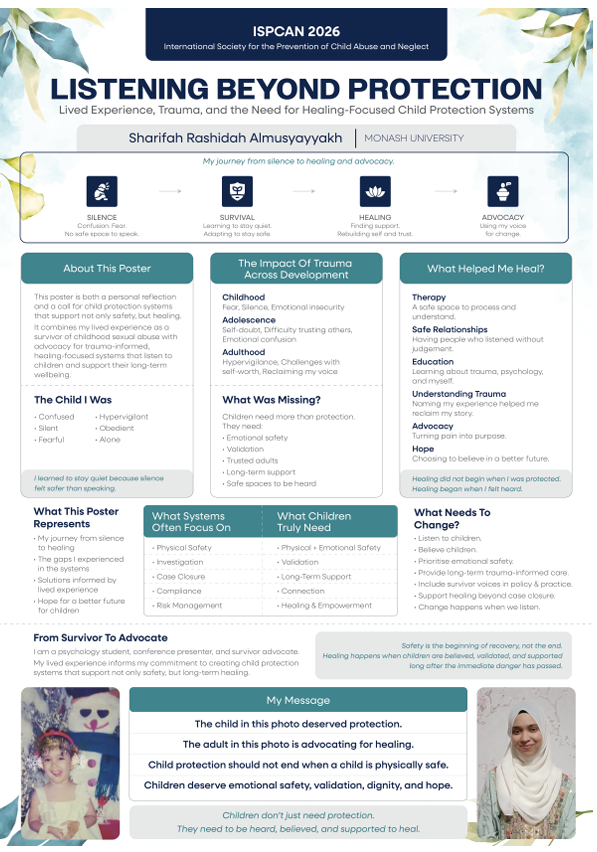
Listening Beyond Protection: Lived Experience, Trauma, and the Need for Healing-Focused Child Protection Systems

Rashidah Almusyayyakh
2nd Place

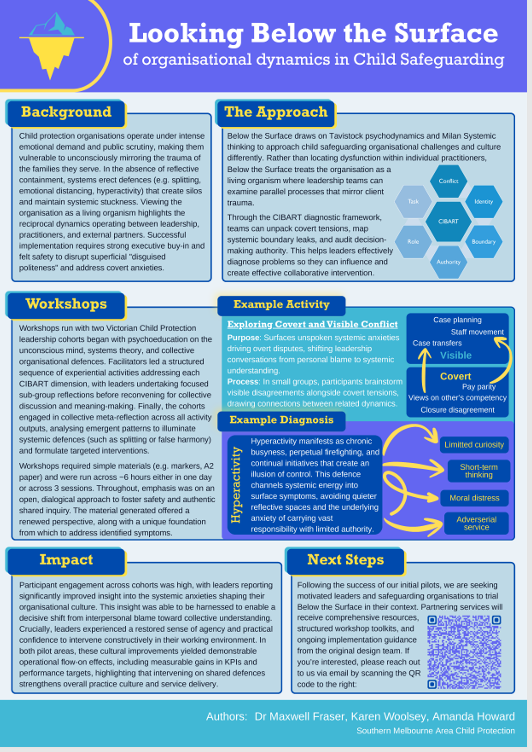
Looking below the surface of organisational dynamics in child safeguarding

Max Fraser
3rd Place

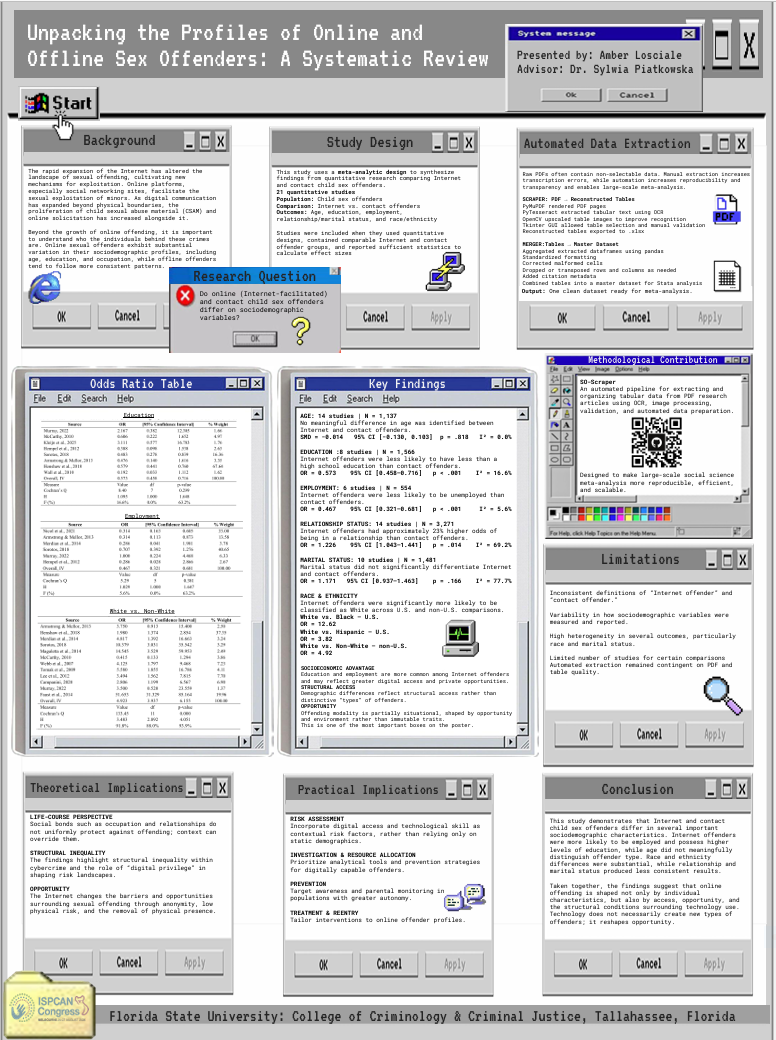
Unpacking the profiles of online and offline sex offenders: a systematic review

Amber Losciale
Special screening & Q&A

Special screening & Q&A: Surviving Malka Leifer

The inside story of a titanic struggle for justice – crossing years and international borders – within Melbourne’s Jewish community.

In 2008, allegations emerged that Malka Leifer, the headmistress of the girls’ campus of an ultra-Orthodox Jewish school in Melbourne’s inner south-east, had committed grievous crimes against three young students under her care, sisters Dassi Erlich, Nicole Meyer and Elly Sapper. It was the catalyst for a reckoning; but before police investigations could get underway, Leifer fled overseas under the cloak of darkness with the assistance of the school. Thus began an extradition battle that would last for the better part of a decade, and a broader quest for justice that revealed a web of international intrigue, legal loopholes and political corruption as well as a deeper culture of silence around sexual abuse.

Adam Kamien has followed up his AACTA-nominated debut, The Speedway Murders, with another excoriating true-crime feature – this time, documenting the struggle undertaken by the sisters and their supporters to bring Leifer back to Australia and help carve out a path for fellow survivors, and what it cost them. Filmed over five years and featuring firsthand testimony from Erlich, Meyer and Sapper alongside interviews with politicians and journalists who worked on the case, Surviving Malka Leifer is a compelling portrait of courage in the face of unimaginable adversity.

Delegate access only

Melbourne presentations

If you attended the Melbourne 2026 Congress and would like to learn more from the authors who presented their work, please use the Congress App from the event to reach out to the authors directly.  

Thank you

A very warm thank you to our Local Partner and Congress Sponsors

ACF provide therapeutic care services and support children and young people who have experienced abuse, violence, and relational trauma—helping them feel safe, seen, and supported as they begin their healing journey.

Across Australia, we work directly with children and families in our national and regional centres. 

✓
Foster care
✓
Child Trauma Service
✓
Harmful sexual behaviours
✓
Kinship care

Principal Partner

Anglicare Victoria